
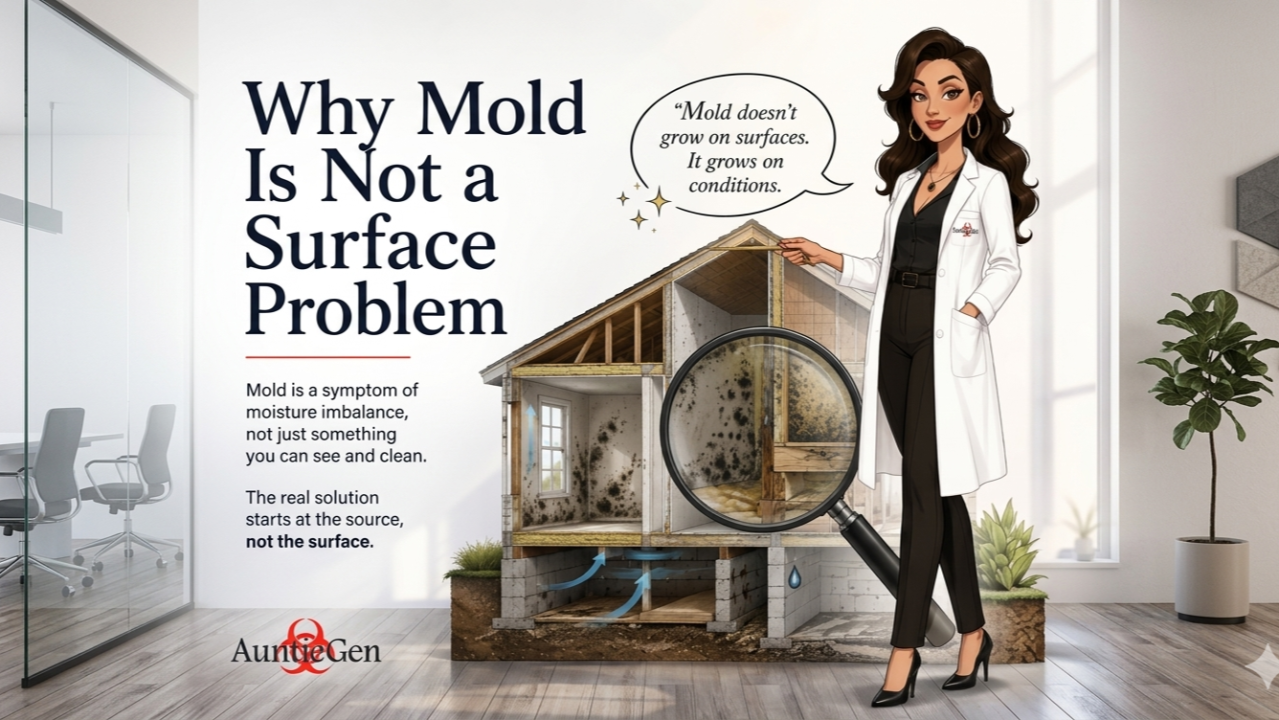
Why Mold Is Not a Surface Problem
One of the most persistent misunderstandings in buildings is the belief that mold is primarily a surface problem.
It is often treated as something that can be cleaned, wiped, or removed in the same way one would address dust or dirt on a material surface.
In practice, mold behaves differently. It is not simply a surface contaminant. It is a biological response to environmental conditions within a building.
Mold growth occurs when three conditions are present at the same time: a moisture source, a suitable temperature range, and an organic material that can serve as a food source. Most common building materials, including wood, drywall, and dust accumulation, can provide that food source under the right conditions.
Because of this, mold growth is rarely isolated to what is visible on a surface. The visible growth is often only a small part of a larger condition occurring within a building assembly.
In many cases, the underlying issue is moisture. That moisture may come from bulk water intrusion, elevated indoor humidity, condensation within building assemblies, or construction-related moisture that was never fully dried before enclosure. These conditions can exist for extended periods before any visible growth appears.
This is why surface cleaning alone often does not resolve the underlying problem. While visible mold can be removed from a material, the conditions that allowed it to develop may still be present. If moisture levels remain elevated or if the source of moisture is not corrected, regrowth can occur over time.
From a building science perspective, mold is more accurately understood as an indicator of moisture imbalance within a structure rather than an isolated surface contaminant. It reflects how a building is performing under real environmental conditions.
This is where the distinction becomes important. If the focus remains only on what is visible, the underlying cause may be missed. When the underlying moisture conditions are addressed, the likelihood of recurring growth is significantly reduced.
At AuntieGen, this distinction is central to how we approach indoor environmental problems. The goal is not only to address what is visible, but to understand why the conditions that allowed growth occurred in the first place.
Because in most cases, mold is not the beginning of the problem.
It is the result of one.
Recent Comments