
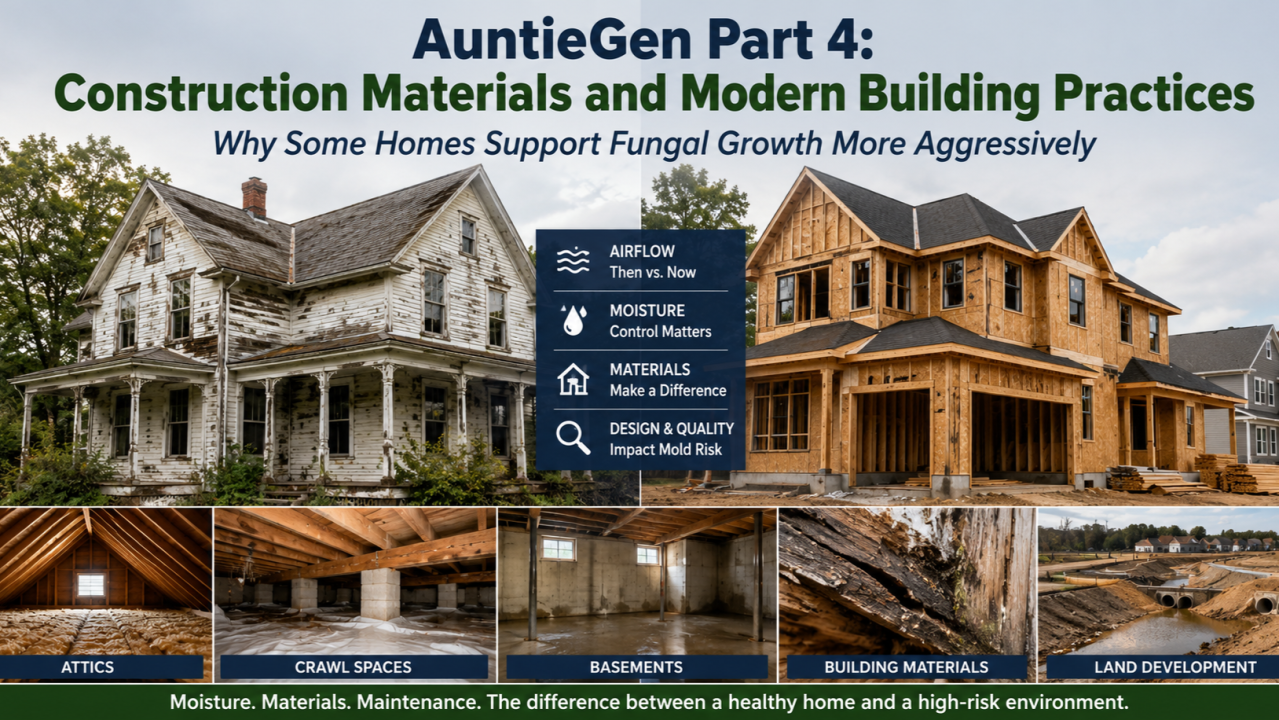
AuntieGen Part 4: Construction Materials and Modern Building Practices
When people think about mold problems, they often assume that moisture alone is the culprit. While water is certainly the primary requirement for fungal growth, the reality is far more complex. The design of a home, the materials used in its construction, the quality of workmanship, and even the way neighborhoods are developed can all influence whether a structure remains healthy or becomes a breeding ground for mold.
One of the most common observations made by homeowners, contractors, and building inspectors is that some homes seem to support fungal growth far more aggressively than others. Understanding why requires looking at how construction practices have evolved over the last century and how those changes have affected the indoor environment.
The Homes of Yesterday Were Not Built the Same Way
Many homes built fifty, seventy-five, or even one hundred years ago were far less airtight than modern construction. Doors and windows leaked air. Wall assemblies were less complex. Attics often had significant natural ventilation, and basements frequently allowed substantial air exchange with the outdoors.
From an energy-efficiency standpoint, these characteristics were far from ideal. Older homes were often expensive to heat and cool because conditioned air escaped continuously. However, this constant exchange of indoor and outdoor air sometimes provided an unintended benefit. Moisture that entered the structure often had more opportunities to dissipate before reaching levels that supported extensive fungal growth.
In many older homes, water vapor could move through building assemblies more freely. Air leakage, while wasteful from an energy perspective, often helped dry wet materials. When minor moisture intrusion occurred, the building’s natural air movement frequently reduced the duration of dampness. Since mold requires both moisture and time to establish colonies, faster drying often meant less opportunity for significant fungal amplification.
This does not mean older homes were immune to mold. Far from it. Many historic homes experienced severe moisture problems, especially around foundations, roofs, and crawl spaces. However, the greater natural airflow present in many older structures often helped limit moisture accumulation in certain areas compared to some modern airtight buildings.
Modern Homes Are Tighter Than Ever Before
Today’s homes are designed with energy efficiency as a primary goal. Air barriers, vapor control systems, advanced insulation packages, and tightly sealed building envelopes help reduce energy consumption and improve comfort.
The challenge is that moisture management becomes much more critical in a tightly sealed structure. If water enters the building envelope through a roof leak, plumbing failure, window defect, foundation issue, or condensation problem, it may not dry as quickly as it would have in a draftier home.
Modern construction requires a delicate balance. The same airtightness that improves efficiency can also trap moisture when systems fail or when ventilation is inadequate. A small construction defect that might have dried harmlessly in an older home can sometimes remain damp for extended periods in a modern structure, creating conditions that support fungal growth.
This does not mean modern homes are inherently worse. In fact, when properly designed, built, and maintained, today’s homes can provide excellent moisture control. The issue arises when moisture enters a tightly sealed building and is unable to escape.
Has Pride in Construction Changed?
Many homeowners believe houses were built better in previous generations. While that statement is difficult to prove objectively, there are some realities worth discussing.
Decades ago, many homes were constructed at a slower pace. Smaller developments, longer construction schedules, and more localized trades often allowed for greater attention to detail during certain phases of construction. Builders frequently remained active in the communities where they worked and developed reputations that followed them for decades.
Today, market pressures often demand faster construction timelines. Large developments may involve numerous subcontractors working simultaneously under tight deadlines. Labor shortages in many regions have also created challenges for the construction industry. Experienced tradespeople remain highly skilled and professional, but the industry as a whole faces increasing pressure to build more homes in less time.
Speed itself does not automatically create mold problems. However, moisture management details require precision. Improper flashing, inadequate drainage design, poorly installed vapor barriers, missing sealants, or insufficient ventilation can create conditions that allow moisture intrusion. The faster a project moves, the more important quality control becomes.
The Wood Is Not Always the Same
One significant difference between historic and modern construction involves lumber.
Many older homes were built using lumber harvested from mature forests. These trees often grew slowly, producing dense wood with tighter growth rings. Much of this material demonstrated excellent dimensional stability and durability.
Modern forestry practices emphasize sustainability and efficiency. Lumber today frequently comes from faster-growing trees harvested at younger ages. While modern lumber remains structurally engineered to meet building code requirements, it can differ in density and moisture characteristics from some historic lumber.
This does not mean old wood was universally superior. Many modern engineered wood products provide remarkable strength and consistency. However, some engineered materials and modern wood products can be more susceptible to moisture damage when exposed to prolonged wet conditions. Once these materials absorb water, they may deteriorate more quickly than certain dense old-growth lumber products found in historic homes.
Mold May Already Be Present Before Construction Is Complete
One factor that receives surprisingly little attention is that fungal growth can begin before a home is even finished. Lumber is often harvested, processed, transported, stored in lumber yards, shipped to job sites, and then exposed to rain, snow, humidity, and changing weather conditions throughout the construction process. During periods of high humidity or repeated wetting, mold can begin growing on framing lumber long before drywall is installed and the home is enclosed.
While surface mold on framing lumber does not necessarily indicate structural damage, it does demonstrate that moisture conditions were present long enough to support fungal growth. In some cases, lumber may arrive at the job site with visible mold already present. In others, mold develops after delivery when building materials are exposed to weather during construction. This is one reason why moisture management during the building process is so important. Allowing wet materials to dry properly, protecting building products from prolonged exposure, and addressing visible fungal growth before enclosure can help prevent moisture-related issues from being permanently sealed within the structure. Once walls, ceilings, and flooring are installed, identifying and correcting these conditions becomes far more difficult and expensive.
Building Materials Have Changed Dramatically
Interior wall systems have also evolved significantly.
Older homes frequently used plaster and lath construction. While plaster is not immune to moisture damage, it is generally denser than modern drywall and contains less cellulose-based material available as a food source for mold.
Modern drywall contains paper facings that can support fungal growth when exposed to moisture. Engineered wood products, composite materials, oriented strand board, and various cellulose-containing products are commonly used throughout modern construction. These materials perform exceptionally well under dry conditions but can become vulnerable when water intrusion occurs.
The issue is not necessarily that modern materials are inferior. Rather, many contemporary materials perform best when moisture is carefully controlled. When they become wet, fungal colonization can occur relatively quickly compared to some traditional building assemblies.
Basements Then and Now
Basements have always been vulnerable to moisture intrusion because they exist below grade.
Older basements often used stone or concrete block foundations with limited waterproofing systems. Water intrusion was common, and many homeowners simply accepted damp conditions as part of basement ownership.
Modern foundations generally incorporate drainage systems, foundation membranes, perimeter weeping tiles, sump systems, and improved waterproofing techniques. When installed correctly, these systems can dramatically reduce water intrusion.
The challenge is that many modern basements are finished living spaces. Finished walls, flooring, insulation, and furnishings create additional materials that can support mold growth if water enters the space. A leak in an unfinished basement is often easier to identify and address than moisture hidden behind finished walls.
Crawl Spaces Then and Now
Older crawl spaces were frequently vented to the outdoors. The theory was that ventilation would remove moisture and keep the space dry.
Research over the last several decades has shown that vented crawl spaces do not always perform as intended, particularly in humid climates. Outdoor air entering a cooler crawl space can actually increase condensation and moisture accumulation.
Many modern building scientists now favor sealed and conditioned crawl spaces when designed correctly. However, these systems require careful installation and maintenance. When moisture enters a sealed crawl space and remains undetected, significant fungal growth can occur.
Attics Then and Now
Attics remain one of the most common areas for mold growth.
Older attics often experienced substantial air movement. While this increased energy loss, it sometimes reduced moisture accumulation.
Modern attics rely on carefully engineered ventilation systems and air sealing details. When these systems function properly, attics can remain dry and healthy. However, inadequate ventilation, bathroom exhaust leaks, duct leakage, or excessive indoor humidity can create ideal conditions for fungal growth.
Because warm, moisture-laden air naturally rises, even minor deficiencies in attic ventilation or air sealing can produce significant moisture accumulation over time.
Land Development and Water Management
Many people wonder whether communities paid more attention to water management decades ago than they do today.
In reality, modern engineering has made tremendous advances in understanding stormwater management, soil conditions, drainage design, hydrology, and groundwater movement. Today’s engineers have access to sophisticated modeling tools and extensive geological data that were unavailable to previous generations.
However, modern development often occurs at a much larger scale. Increased urbanization, larger paved surfaces, changing weather patterns, and higher housing density can create new drainage challenges.
A properly engineered modern subdivision may outperform many historic developments in terms of water management. At the same time, any development can experience problems if grading, drainage infrastructure, foundation design, or stormwater systems are inadequate or poorly maintained.
Ultimately, the quality of implementation matters just as much as the quality of the design.
The Real Lesson
The question is not whether old homes are better than new homes or vice versa.
Older homes benefited from natural airflow, simpler building assemblies, and often denser construction materials. Modern homes benefit from superior engineering, better waterproofing systems, advanced building science, and dramatically improved energy efficiency.
The common denominator in every era is moisture control.
The homes that remain healthiest are not necessarily the oldest or the newest. They are the homes where moisture is effectively managed, airflow is properly designed, maintenance issues are addressed promptly, and hidden water intrusion is identified before fungal growth has an opportunity to become established.
Whether your home was built in 1925, 1975, or 2025, the principles remain the same. Moisture left unchecked will eventually create opportunities for fungal growth, regardless of the age of the structure or the materials used to build it.
At AuntieGen, we understand that every home has its own unique challenges. Our goal is to help homeowners, buyers, sellers, builders, and property managers identify potential risks, understand the factors contributing to indoor environmental concerns, and take proactive steps toward creating healthier indoor spaces. No matter when your home was built, AuntieGen is here to help.
For More: Ask AuntieGen
@functionalmedicinedoctors
@Moldsensitivepeople
@Toxicmold
Recent Comments